

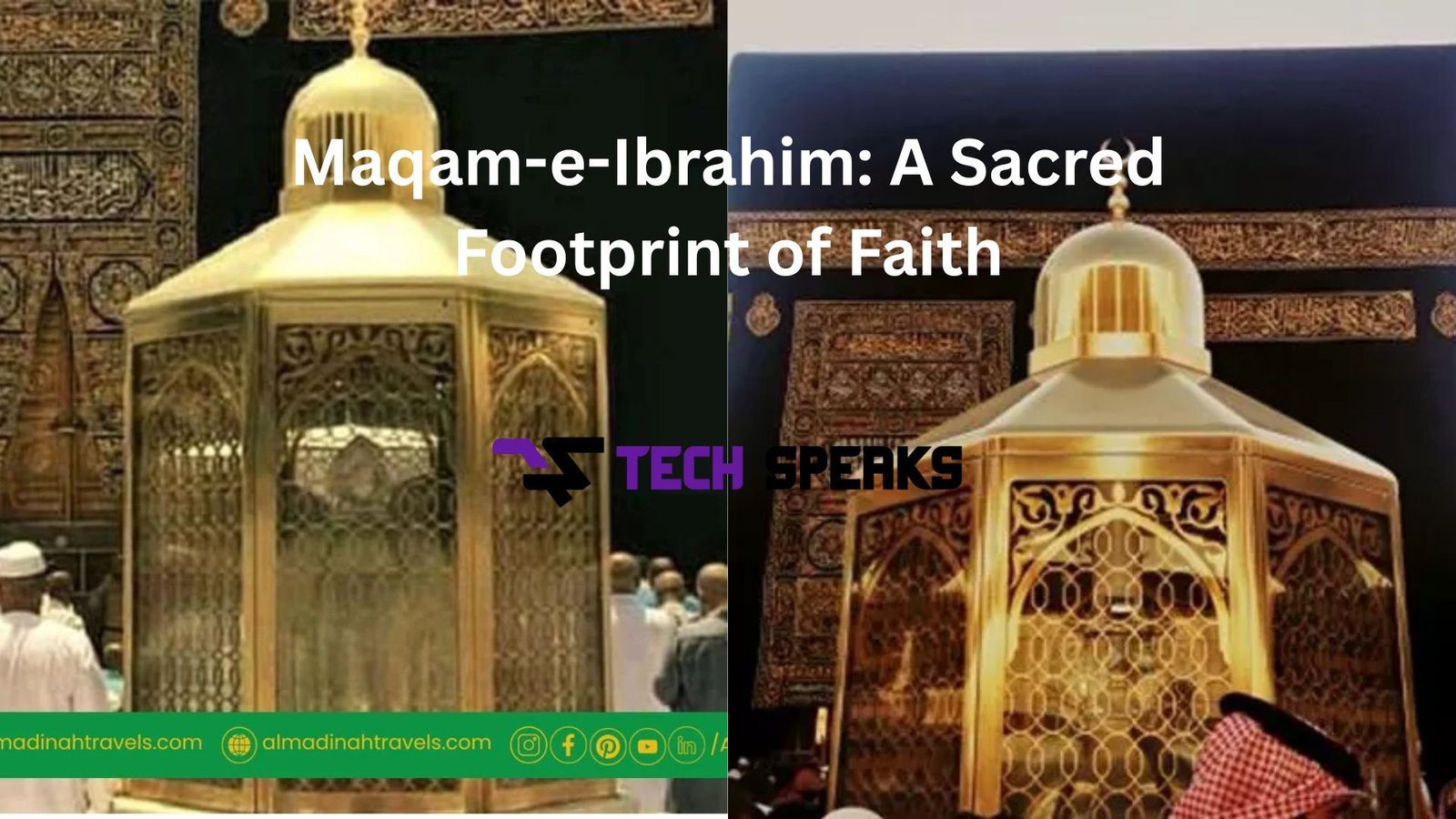
Maqam-e-Ibrahim is one of the most revered and iconic places in Islam. It stands as a symbol of unshakable faith, divine instruction, and the deep spiritual connection between Allah and His prophets. When you visit Masjid al-Haram in Makkah, you’ll see this small yet significant site enclosed in a golden, crystal dome—a stone with the footprint of Prophet Ibrahim (AS).
But what is the real story behind this sacred stone? Why do millions of Muslims face it in prayer and stop beside it during Hajj and Umrah? Let’s dive into a simple and heartfelt exploration of Maqam-e-Ibrahim, one of the most awe-inspiring sacred sites in Makkah.
What is Maqam-e-Ibrahim?
Literally, the term Maqam-e-Ibrahim translates to the “Station of Ibrahim”.
It refers to a rock bearing the imprint of the feet of Prophet Ibrahim (AS). According to Islamic tradition, this stone is the very spot where Prophet Ibrahim (Abraham, peace be upon him) stood while building the Kaaba—the holiest structure in Islam—along with his son, Prophet Ismail (AS).
Quick Facts:
- Location: Just a few meters away from the Kaaba, inside Masjid al-Haram, Makkah.
- Significance: Contains the preserved footprints of Prophet Ibrahim (AS).
- Material: A stone believed to have miraculously softened under the Prophet’s feet.
- Encasement: Enclosed in a golden-bronze and glass casing to protect and preserve it.
The Story Behind Maqam-e-Ibrahim
To understand the depth of its importance, let’s go back in time—thousands of years ago.
The Building of the Kaaba
After Prophet Ibrahim (AS) left his wife Hajrah (Hagar) and son Ismail (AS) in the barren desert of Makkah (by Allah’s command), the area gradually became habitable. When Ismail grew older, Allah ordered Ibrahim (AS) to build the Kaaba, the first house of worship, on that very land.
As they worked together to raise the walls of the Kaaba, Ibrahim (AS) stood on a large stone. While he lifted and placed the stones, the stone he was standing on miraculously rose and lowered, helping him reach different heights of the structure. His feet left a clear mark on the stone, which remains preserved to this day.
“And [mention] when We designated for Abraham the site of the House… Take, [O believers], from the standing place of Abraham a place of prayer.” — Surah Al-Baqarah (2:125)
This is the origin of Maqam-e-Ibrahim.
Personal Anecdote: A Pilgrim’s First Glimpse
Fatimah, a 47-year-old woman from Indonesia, shared her experience of seeing Maqam-e-Ibrahim during her first Umrah:
“When I finally reached Masjid al-Haram, I felt overwhelmed. The Kaaba was right in front of me, and then my eyes caught the glowing golden frame not far away. That was Maqam-e-Ibrahim. I couldn’t believe I was seeing the exact place where Prophet Ibrahim (AS) stood. Tears just came pouring down. It felt like I was walking through history.”
Why is Maqam-e-Ibrahim So Important in Islam?
You might wonder: why does a simple rock matter so much? The answer lies in faith, history, and divine command.
1. Connection to a Prophet’s Legacy
Prophet Ibrahim (AS) is known as the Khalilullah—the Friend of Allah. He is respected not only in Islam, but also in Judaism and Christianity. His acts of obedience, including leaving his family in the desert and building the Kaaba, are remembered with deep reverence.
2. Part of the Hajj and Umrah Journey
Pilgrims performing Hajj and Umrah are required to pray two rakats of Salah behind Maqam-e-Ibrahim after completing Tawaf (circumambulation of the Kaaba). This act directly connects worshippers to a moment in prophetic history.
3. Mentioned in the Quran
As mentioned earlier, Allah directly references Maqam-e-Ibrahim in the Quran, commanding believers to take it as a place of prayer.
How to Perform Prayer Behind Maqam-e-Ibrahim (Step-by-Step)
If you’re planning to visit Masjid al-Haram and wish to follow Islamic tradition, here’s a simple guide:
Step 1: Complete Tawaf
Perform seven rounds around the Kaaba in an anti-clockwise direction. This is Tawaf.
Step 2: Locate Maqam-e-Ibrahim
After finishing your Tawaf, look a few meters away from the Kaaba. You’ll see a golden glass structure—it’s Maqam-e-Ibrahim.
Step 3: Pray Two Rakats
Find a place behind the Maqam (not necessarily very close due to the crowd) and perform two rakats of Salah. This prayer is a Sunnah and a beautiful way to follow in the footsteps of the Prophet ﷺ.
Tip: Due to the heavy crowd during Hajj and peak Umrah seasons, many scholars permit praying these rakats anywhere in the mosque behind Maqam-e-Ibrahim.
Physical Description of Maqam-e-Ibrahim
The actual stone is about 50 cm x 50 cm, slightly yellow in color, and has clear indentations where the Prophet’s feet once stood. The footprints are slightly depressed into the stone, suggesting that the stone softened under divine command to record this moment.
Over the centuries, to protect the stone from weather and human touch, it was encased in various structures. Today, it is preserved inside a crystal glass dome with a gilded bronze frame. It’s impossible to miss due to its glowing appearance near the Kaaba.
Historical Evolution of Maqam-e-Ibrahim
Early Years
In the early days of Islam, Maqam-e-Ibrahim was just a stone left in the open. As the number of pilgrims increased, it became necessary to protect and preserve it.
Ottoman Era
During the Ottoman rule, a more durable casing was added. This also marked the beginning of serious preservation efforts.
Saudi Era
In modern times, the Saudi government has taken great steps to protect sacred sites in Makkah. Maqam-e-Ibrahim now sits securely inside a climate-resistant glass and metal enclosure, ensuring it can be viewed by generations to come.
Maqam-e-Ibrahim and Its Place Among Other Sacred Sites
Maqam-e-Ibrahim is not just a historical site—it’s a living piece of Islamic heritage. Alongside places like:
- Zamzam Well
- Mount Safa and Marwah
- The Black Stone (Hajr al-Aswad)
- Mina, Arafat, and Muzdalifah
…it forms part of the spiritual map every pilgrim walks during Hajj and Umrah.
Spiritual Lessons from Maqam-e-Ibrahim
Obedience
When Prophet Ibrahim (AS) was told to build the Kaaba, he did it without question—even though he was old and the task was hard.
Family in Faith
Prophet Ismail (AS) helped his father in this divine task, showing that faith is also a family journey.
Leaving a Legacy
Ibrahim (AS) left not just a physical footprint but a spiritual legacy that every Muslim today remembers and honors.
Hadith on Maqam-e-Ibrahim
The Prophet Muhammad ﷺ himself emphasized the importance of this site.
“The stone is the station of Ibrahim. Allah commanded him to call the people to Hajj, and his call was heard.” — (Tafsir of Ibn Kathir)
This hadith confirms not just the physical importance of the place but also its spiritual power to connect generations.
Planning to Visit Maqam-e-Ibrahim? Here’s What to Know
If you’re preparing for Umrah or Hajj, here’s how you can make the most of your experience at Maqam-e-Ibrahim:
Pro Tips:
- Learn its history before going – This helps deepen your emotional and spiritual connection.
- Visit during off-peak hours – If possible, go early in the morning or late at night to avoid crowd pressure.
- Be patient and respectful – Many people will be around. Give others space and take your time.
- Take a moment to reflect – This isn’t just a photo opportunity. Pause and think about the journey of Prophet Ibrahim (AS).
FAQs about Maqam-e-Ibrahim
Can I touch the stone of Maqam-e-Ibrahim?
No. The stone is enclosed in glass for protection. It is not allowed to touch or kiss it.
Do I have to pray exactly behind the stone?
No. It is preferable to pray behind it, but due to crowding, you can pray anywhere behind it within the mosque.
Is Maqam-e-Ibrahim part of Hajj rituals?
Yes, it is part of the Tawaf ritual in both Hajj and Umrah, where two rakats are offered behind it after Tawaf.
Final Thoughts: A Small Stone, A Huge Legacy
In the grand expanse of Masjid al-Haram, Maqam-e-Ibrahim might seem like a small object. But spiritually, it is massive. It’s a symbol of faith, a reminder of obedience, and a testament to the deep-rooted legacy of Prophet Ibrahim (AS).
Every year, millions of Muslims gaze upon it, pray behind it, and walk past it during their journey of Hajj and Umrah. But its true beauty lies not just in its history, but in what it continues to teach us—that even a single step made with sincerity can echo through eternity.
